Jason Schultz
Biography
Jason M. Schultz is a Professor of Law, Director of NYU's Technology Law & Policy Clinic, and Co-Director of the Engelberg Center on Innovation Law & Policy. His clinical projects, research, and writing primarily focus on practical frameworks and policy options to help traditional areas of law such as intellectual property, privacy, consumer protection, and civil rights adapt in light of new technologies and the challenges they pose. His most recent work focuses on the social and legal implications of machine learning, artificial intelligence, and the Internet of Things.
From 2024 - 2025, Professor Schultz served as Global Head of AI Policy at Canva where he worked with the company’s research, engineering, business, and legal teams on responsible AI practices in light of rapidly evolving global AI regulations.
From 2016 - 2017 Professor Schultz worked at the White House Office of Science and Technology Policy, where he served as Senior Advisor on Innovation and Intellectual Property to U.S. Chief Technology Officer Megan Smith.
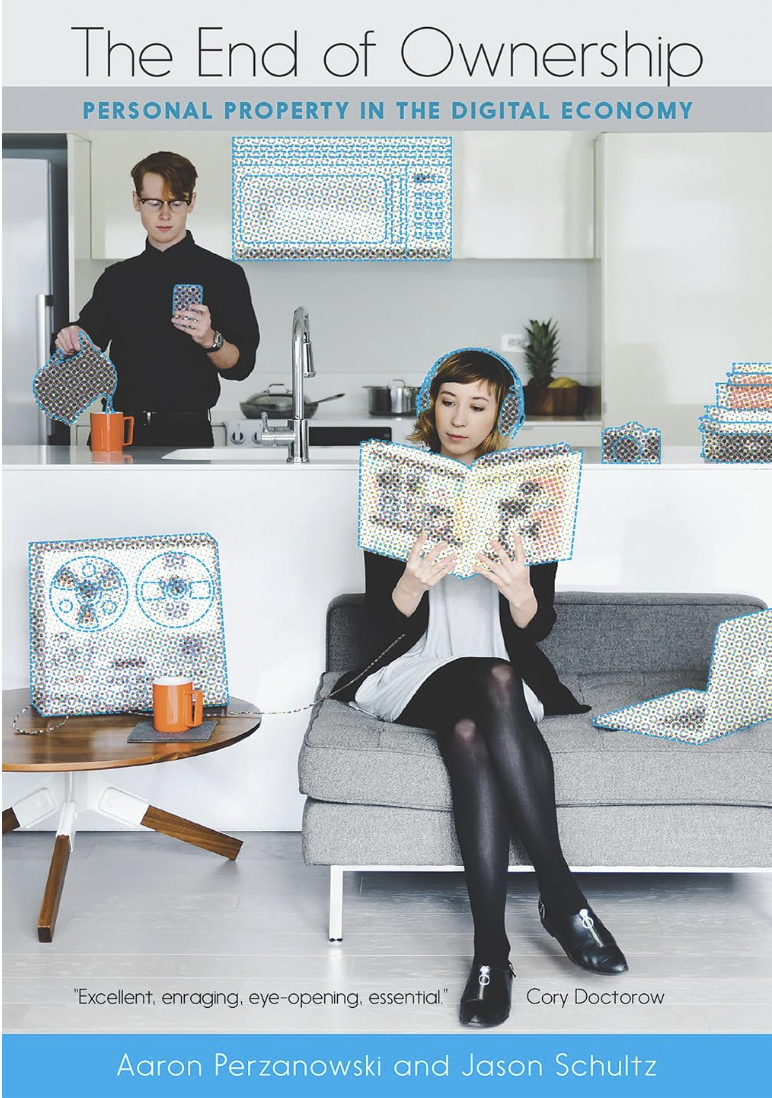
With Aaron Perzanowski, he is the author of The End of Ownership: Personal Property in the Digital Economy (MIT Press 2016), which argues for retaining consumer property rights in a marketplace that increasingly threatens them.
Prior to joining NYU, Professor Schultz was an Assistant Clinical Professor of Law and Director of the Samuelson Law, Technology & Public Policy Clinic at the UC Berkeley School of Law (Boalt Hall). Before joining Boalt Hall, he was a Senior Staff Attorney at the Electronic Frontier Foundation (EFF), one of the leading digital rights groups in the world and before that practiced intellectual property law at the firm of Fish & Richardson, PC. He also served as a clerk to the Honorable D. Lowell Jensen of the Northern District of California. He is a member of the American Law Institute.
Courses Taught
Innovation Policy Colloquium, Advanced Technology Law and Policy Clinic , Technology Law and Policy Clinic, Technology Law and Policy Clinic Seminar, 1L Reading Group: Authorship and Other So-called Acts of Creativity in the Age of AI, 1L Reading Group: Generative AI and the Future of Legal Automation, Survey of Intellectual Property (for 1Ls), 1L Reading Group: Machines as Legal Adversaries and Allies
Education
JD Law & Technology, UC Berkeley School of Law
BA Public Policy & Women's Studies, Duke University
Institutions
New York University School of Law
UC Berkeley School of Law
Canva
White House Office of Science and Technology Policy
Topics
Intellectual Property
Privacy
Consumer Protection
Civil Rights
Legal Implications of Artificial Intelligence
Legal Implications of the Internet of Things
Perzanowski and Schultz start off by providing a fine summary and analysis of both how clouds and content streaming work and the implications in terms of ownership and rights.... As the book shows quite beautifully... there is a perverse incentive for many of those involved to keep the whole story as obscure and unfathomable as possible. This analysis—detailed and impressive—shows how the combination of law and technology works against the users. —Times Higher Education
This is a lively must-read account of how digital formats have led to an unprecedented transformation of property law. Perzanowski and Schultz are law professors who specialize in intellectual property, and they argue that consumers need to be aware of the tradeoffs that come with the so-called freedom of cloud storage and streaming services. —Ars Technica
The End of Ownership presents the confusing world of the digital consumer in wonderfully accessible prose, replacing hideous jargon with the simplest of analogies, from thieving bookshops to the goblins from Harry Potter. It will answer the questions you have regarding digital ownership, and it's inevitable that more than a few of them have never even crossed your mind. In an increasingly complex world, plagued by unreadable (certainly unread) terms and conditions, it is more than a little refreshing to have something explained in good, plain English. —E & T: Engineering & Technology
Other Publications
Articles
"The Legal Imitation Game: Generative AI’s Incompatibility with Clinical Legal Education," 92 Fordham L. Rev. 1867 (2024) (with Jake Karr)
"Generative AI is a Crisis for Copyright Law," Issues Sci. & Tech., Winter 2024, at 79 (with Kate Crawford)
"The Work of Copyright Law in the Age of Generative AI," Grey Room, no. 94, Winter 2024, at 56 (with Kate Crawford)
"Pam Samuelson and the Emergence of the Technology Law and Policy Clinical Movement," 39 Berkeley Tech. L.J. 1117 (2024)
"The Anti-Ownership Ebook Economy: How Publishers and Platforms Have Reshaped the Way We Read in the Digital Age," (July 2023) (with Sarah Lamdan, Michael Weinberg and Claire Woodcock)
"Preserving the Royalty-free Standards Ecosystem," 45 Eur. Intell. Prop. Rev. 371 (2023) (with Jorge L. Contreras, Rudi Bekkers, C. Bradford Biddle, Enrico Bonadio et al.)
"The Right of Publicity: A New Framework for Regulating Facial Recognition," 88 Brook. L. Rev. 1039 (2023)
"A Framework for Deprecating Datasets: Standardizing Documentation, Identification, and Communication," Proc. ACM Conf. Fairness, Accountability & Transparancy 199 (2022) (with Alexandra Sasha Luccioni, Frances Corry, Hamsini Sridharan, Mike Ananny et al.)
"AI Systems as State Actors," 119 Colum. L. Rev. 1941 (2019) (with Kate Crawford)
"Dirty Data, Bad Predictions: How Civil Rights Violations Impact Police Data, Predictive Policing Systems, and Justice," 94 N.Y.U. L. Rev. Online 192 (2019) (with Rashida Richardson and Kate Crawford)
"Limitless Worker Surveillance," 105 Cal. L. Rev. 735 (2017) (with Ifeoma Ajunwa and Kate Crawford)
"Legislating Digital Exhaustion," 29 Berkeley Tech. L.J. 1535 (2015) (with Aaron Perzanowski) Abstract
"Big Data and Due Process: Toward a Framework to Redress Predictive Privacy Harms," 55 B.C. L. Rev. 93 (2014) (with Kate Crawford) Abstract
"Reconciling Intellectual and Personal Property," 90 Notre Dame L. Rev. 1211 (2014) (with Aaron Perzanowski) Abstract
"Protecting Open Innovation: The Defensive Patent License as a New Approach to Patent Threats, Transaction Costs, and Tactical Disarmament," 26 Harv. J.L. & Tech. 1 (2012) (with Jennifer M. Urban)
"The Unending Search for the Optimal Infringement Filter," 122 Colum. L. Rev. Sidebar 83 (2012) (with Sonia Katyal)
Book Chapters
Is Patent Reform via Private Ordering Anticompetitive? An Analysis of Open Patent Agreements, in Patent Pledges: Global Perspectives on Patent Law's Private Ordering Frontier 151 (Jorge L. Contreras and Meredith Jacob, eds., Edward Elgar, 2017)
Digital Copyright Exhaustion and Personal Property, in Research Handbook on Intellectual Property Exhaustion and Parallel Imports 518 (Irene Calboli and Edward Lee, eds., Edward Elgar Publishing, 2016) (with Aaron Perzanowski)
"Clues" for Determining Whether Business and Service Innovations Are Unpatentable Abstract Ideas, in Perspectives on Patentable Subject Matter 8 (Michael B. Abramowicz, James E. Daily and F. Scott Kieff, eds., Cambridge University Press, 2015) (with Pamela Samuelson)
Short Articles
"The Potential for Expanding Provision of Misoprostol-Only Abortions by Nurse Practitioners and Pharmacists: A Legal Analysis," 127 Contraception, November 2023, art. 110159 (with Navya Dasari, Sarah Baum and Caitlyn Gerdts)
"Litigating Algorithms 2019 US Report: New Challenges to Government Use of Algorithmic Decision Systems," AI Now Institute (Sept. 2019) (with Rashida Richardson and Vincent M. Southerland)
"Litigating Algorithms: Challenging Government Use of Algorithmic Decision Systems," AI Now Institute (Sept. 2018)
"Algorithmic Impact Assessments: A Practical Framework for Public Agency Accountability," AI Now Institute (April 2018) (with Dillon Reisman et al.)
Columns
"The Internet of Things We Don’t Own?," Comm. ACM (ACM/New York, N.Y.), May 2016, at 36