Jostein Hauge On The Rise of China, Its Relationship With The West, & The Future of Manufacturing
By Aiden Singh, August 3, 2026
Jostein Hauge is a political economist & Associate Professor in Development Studies at the University of Cambridge, based at the Centre of Development Studies and the Department of Politics and International Studies.

The Rise of China
Aiden Singh: You’ve argued that the rise of China is good for the world. Can you share your case with our readers?
Jostein Hauge: Sure. I think we can start with the fact that China has lifted more people out of poverty than the rest of the world put together over the past fifty years. If we care about poverty reduction and international development, China's rise is the most significant and impressive feat of poverty reduction we have seen. If I remember the data correctly, something like 900 million people have been lifted out of poverty within China's borders. That data can be found in publications by the World Bank and by Our World in Data. The level of poverty eradication and the economic development that has happened is a remarkable feat given China's scale and population.
Another important development is how China is emerging as a clean energy juggernaut. It now produces more than two-thirds of the world's solar panels, wind turbines, lithium-ion batteries, and electric vehicles. It is really emerging as the one country giving us hope to deal with climate change. Of course, China's growth has involved increasing emissions, but those emissions are now flattening, and we are gradually seeing that China's clean energy efforts are hugely offsetting the emissions its growth has entailed.
Another positive aspect of China's rise, from a global point of view, is that I believe it is leading us toward a more multilateral world. In the post-1945 era, the world order has largely been dictated and dominated by the West, especially the United States. I believe that if we want a world order that is truly democratic in the global sense, we need some counterweight to that - and I believe China provides it. China has also proven, in its actions, to be less warmongering and less imperialistic than countries like the United States. This is not to say China is a fully benevolent force, but I do believe it moves us closer to multilateralism on the world stage and gives a stronger voice to countries in the Global South, which I think is desperately needed right now.
So these are three things I would want to point out when it comes to why China's rise is good for the world.
Aiden Singh: Let’s talk about the process by which China has been developing. Its approach to economic progress has been described as "export-led development". Is this an accurate characterization of its approach, and if so, can you explain the mechanics of this approach?
Jostein Hauge: I definitely think it is accurate to characterize China's growth as export-led.
There are countries before China that embarked on this path, such as South Korea, Japan, and Singapore. Generally in East Asia, we have seen countries grow fast and develop fast technologically through exporting.
There are many reasons why this matters. One is that when you start exporting manufactured goods - goods we think of as high value-added - this is a sign that you are producing things that are desired in the world economy - that you are competitive. And it is also a sign of technological development. So it is not only about exporting; it is about exporting things that are gradually more and more technologically sophisticated, as a way of developing technologically.
There are also aspects of exporting that have to do with earning foreign currency, creating jobs, and, quite often, attracting foreign capital, with the idea of using that capital to generate exports for other countries and serve other markets. So there is an economic development dimension there as well, and China has certainly followed this path.
I think it is correct to say that China has followed a path where it tried to unleash the productive forces of the economy and become a technological powerhouse, focusing on investing in manufacturing. That has been the recipe for economic development for a century, since the Industrial Revolution. Most large economies need to move from an agricultural stage to an industrial stage as an initial step in developing their economy, and that also comes with exporting, since in theory all manufactured goods can be exported. So it is a story about the desire to export, but also a story about developing the economy technologically and focusing on high rates of investment in productive sectors, especially manufacturing.
Aiden Singh: You mentioned Korea as another example. You’ve also looked into other countries that developed their economies in different periods of history, in different parts of the world. Is export-led development the most reliable approach to economic development?
Jostein Hauge: I would say that if we look at the history of economic development over the past hundred years, it has always entailed a surge in exports, because if a country does not export, it normally does not embark on this path of technological development. You will not find a case of a large economy that has developed fast without this. If we think of economic development as a process of technological development, it always entails exports.
There are some exceptions. For example, Saudi Arabia and other countries in the Arabian Peninsula have grown by exporting natural resources such as oil and gas. Small island states like the Seychelles or Mauritius might also do things differently because of their very small size.
Historically, though, the link runs from making things that are in high demand - both domestically and on the world market - well and then exporting them. That is also why most of the countries with huge trade surpluses today are generally quite well developed.
Aiden Singh: What China makes has shifted over time.
The country has been referred to as "the world's factory" and, until recently, was known primarily for manufacturing cheaper, low-tech goods.
But today, it competes in higher-tech and innovative industries such as electric vehicles and AI.
Is China in the process of moving up the value chain? If so, how has the change occurred? How likely is it to succeed in competing in the most cutting-edge industries?
Jostein Hauge: Yes, definitely. It is unambiguously moving up the value chain, both in terms of what it makes and what it exports. I would go as far as to say that China is now at the technological frontier in most global industries, which is interesting because we have not seen this before: a country with a GDP per capita that is one-sixth of the United States, or one-third in purchasing power terms, essentially an upper-middle-income economy, or at the very low end of a high-income country, and yet one of the technologically leading nations in the world.
It still makes the simple things too. We are seeing some outsourcing of the manufacture of toys, furniture, and other basic goods to other Southeast Asian economies, but a lot of it is still done in China.
China is also making more complicated things, electric vehicles being a good example, where it is a leading country in the world without question, along with batteries and drones, and to some degree smartphones as well.
I live in London, so I do not see the full extent of Chinese products here, or their technological sophistication, because there are some barriers to trade.
But if you go to China and see the auto industry there, the range of Chinese brands is as good as, if not higher quality than, cars in the West. The same is true of televisions and smartphones. It is mind-boggling. There are areas where China has clearly surpassed the West, for example infrastructure development. China has the best rail system in the world, in terms of both quality and scale. Its trains are impeccable, extremely fast, and extremely technologically sophisticated. The same can be said for the train stations and the extent of the road network. That is a level above the West.
The few industries where China still lags a little are perhaps aerospace, where the United States and Europe remain somewhat ahead with Airbus and Boeing, and semiconductors. But that is changing very fast. China is proving it can soon make chips as complex as the AI chips Nvidia makes, and it is apparently now producing better large language models than we are seeing out of the United States, at least from what I am reading, with reports that Chinese labs are surpassing companies like OpenAI and Anthropic. Given what we have seen in just the past ten to fifteen years, I would be very surprised if, in ten years, China is not at the cutting edge of every single global industry technologically.
I want to caveat this by saying that technological sophistication is one indication of dominance. Another is reach, branding, popularity, and structural power, and I still think American corporations have high structural power. Apple as a brand is much more powerful globally than any Chinese brand. That is also why, if you go to China, you see the prevalence of American brands in the service sector and the corporate sector, more so than you see Chinese brands in the United States or across the world.
Aiden Singh: Do you think that is likely to continue or is there a chance domestic consumers in China might move more toward Chinese brands over time, at the expense of Western companies like Apple?
Jostein Hauge: We will see. One thing China knows how to do really well is make products that are high quality at a relatively low price, increasingly even at the luxury end. But when it comes to the popularity of Apple iPhones, or even the popularity of Hollywood movies, although America has lost much of its industrial base and its ability to make things as efficiently as China, the popularity of American culture and the ability to market American brands extremely successfully around the world will give some American brands an edge for a while.
I do think that if we look at the export of goods in the world, China dominates, but when we look at the export of services, the United States is by far the dominant force. That is not something we hear much about today, and it is captured in the exports of corporate services by big consulting firms, by tech firms, and by culture, including movies.
So we might see a shift, but I do think brand dominance globally will also require the successful export of culture, and that is not something we see yet with China.
There is a difference, though, between what the West consumes and what the Global South consumes. If you go to Brazil, Vietnam, or Nepal, you will see far more Chinese brands than you would in the West.
But linguistically and culturally, the Anglo-Saxon world still dominates globally.
Aiden Singh: How did China’s move up the value chain toward the production and export more technologically sophisticated goods occur? Was it a conscious policy decision to make that move?
Jostein Hauge: Yes, completely. The idea of industrialization, and of using industrial policy, can be traced all the way back to Mao Zedong, and then through Deng Xiaoping, and now Xi Jinping. Leaders have often talked about the need to raise high rates of investment in productive sectors of the economy, and to see poverty eradication as a process of ensuring the material needs of the population are met.
That started with building industry at mass scale to employ people and develop economically, but also to make the things people actually need. I mentioned infrastructure as one element, but consumer goods matter too, although consumption in China is not yet at the level it perhaps should be.
One thing that stands out when you are in China is that there is really nothing they cannot make. That is a powerful remedy for eradicating poverty: having the technological ability to produce at mass scale whatever people need. This has been a central idea in the development process.
The state sees its legitimacy as being sustained through economic development. China is not a democracy in the Western liberal sense. But it sees its purpose as staying in power and remaining popular and legitimate with the public by continuing to deliver economic development and growth. That is also why industrial policy has been so central, and why there have been measures to raise investment in needed sectors of the economy through financial repression policies and state-owned enterprises.
These things can certainly go wrong, but largely because the Chinese state has been able to create a system that, although not democratic, is certainly meritocratic, it has had competent people in charge who have been able to make the right decisions.
Aiden Singh: How does China's pace of development compare to other historical cases?
Jostein Hauge: It is probably comparable to the pace of Korea between 1960 and 1990, and maybe also Singapore around that time, where a country moves from low to high income over a period of thirty, forty, or fifty years.
But it is the scale of China that makes it very unique. We have not seen a country go from being marginal in global manufacturing to completely dominating global manufacturing at such a scale.
So the pace of growth has been seen before, but the pace combined with the scale has never been seen before. This is the largest experiment in development witnessed in human history.
Aiden Singh: What are some of the limitations of China's development model?
Jostein Hauge: One thing we are seeing now is that China exports a great deal without importing as much, alongside deflationary pressures.
One of the things China has done is pit firms against one another across different regions. There are state-owned firms that control the commanding heights of the economy, such as banking and rail, but when you look at the consumer goods sector, private firms compete, coming from different provinces. It is often important for government officials in the provinces, and for firms in those provinces, to prove themselves, because doing so brings more funding. So firms have competed against one another in internal competitions within China.
The upside is that the firms that survive this internal capitalist process are very well equipped to compete globally, but the price of things has gone down a great deal as a result. Sometimes this leads to over-production, a phenomenon often called over-capacity, or too much investment in construction, and we have seen too many houses built in certain areas of the country due to over-investment.
If this reaches the point of deflation in China, that is a real worry, because deflation is not something you want from an economic point of view, for consumer sentiment, for debt dynamics, and so on. So deflationary pressure is one weakness of this enormous investment drive combined with insufficient domestic consumption. This is an aspect of China's economy that the government has explicitly said it is worried about and wants to address in the next five year plan, with a focus on more consumption.
You could also say that China is a case of state-led development sustained over the long term, with one party, the Chinese Communist Party, in charge for a very long time. This is a model that many people find difficult to fully grasp.
The danger, of course, is if predatory leaders end up in charge. In liberal democracies, leaders are regularly swapped out through the ballot box to ensure power does not become too concentrated. In China, power is concentrated in one party, so as long as that party manages to maintain a meritocratic structure, this is beneficial.
But the danger is that there are not many checks and balances on power, and if despotism, corruption, or predation take hold at the top, which has not really happened yet at large scale, then what we might call “developmental authoritarianism” could turn into “predatory authoritarianism.”
- - - - - - -
China & the West
Aiden Singh: You mentioned the different political systems of the West and China. Do differences in the political systems of a place like the United States and China affect their respective abilities to implement long-term industrial strategy?
Jostein Hauge: Yes, and I think we have seen this play out.
China has the ability to make long-term plans because one party is in charge, in theory for an unlimited amount of time.
In the United States, by contrast, the political system has developed so that when the opposing party comes into power after a term governed by the other party, it often moves to dismantle much of what that other party has done. For example, the industrial policies Biden pursued around clean energy technology are something Trump opposes.
So when you have a structure in place where you cannot plan beyond a three- or four-year time horizon, long-term strategy becomes very difficult.
This is not an argument against democracy, but it is an argument against a political system defined by constant, fierce fighting between two parties, with no long-termism built into government institutions.
Aiden Singh: You have made the case that China's economic rise is good for the world. But if you are a political leader in the West, should you be concerned about China's economic rise over the last few decades, from a geopolitical perspective and also from a domestic voter perspective?
Jostein Hauge: It depends somewhat on which country you are from.
Norway, for example, does not worry too much about China right now. It cares more about Russia, because it does not have industrial jobs that could potentially be lost to China.
Germany cares much more about China, out of fear that its automotive sector might be eroded by China's dominance there.
The United States is very central to this dynamic right now, with huge interdependence between the two countries economically, and it is a country where this debate about China's rise is very central.
There are certain areas where even the United States has benefited economically from China's rise, particularly access to cheap consumer goods. We have seen a huge drop in the price of imported manufactured goods in the United States over recent decades, something not talked about much these days, but which has also helped keep service sectors afloat and avoid significant inflation.
Certain American corporations have also benefited from China's rise. Apple is an example: between 2014 and 2025, roughly a quarter of Apple's operating profit came from activities in China.
So there are clear direct economic benefits a country like the United States gets from China.
That said, any country should care about sovereignty, its industrial base, and its economy, so to the degree you want an economy that works for American jobs, you need smart industrial and trade policies in place vis-à-vis China.
I do think this can be compatible with having a friendly approach toward China, and I think Trump has hinted at that, particularly after his last visit, although he has many people in his administration who are quite hawkish toward China.
Spain is one country actually trying this approach right now, attracting more investment from China in automotives to create joint ventures, and I think we will increasingly see this in the United States as well.
I also think there is a reason for a mood shift in the United States. Research from the Carnegie Endowment shows that among young people there is a growing number who say they would not be particularly troubled if China overtook the United States as a superpower, which is quite interesting. There is a slow sentiment shift, especially among the American public, that China is not the boogeyman it is often made out to be.
That has yet to reach the minds of politicians in the Republican Party, and I think in the Democratic Party as well - the so-called "hawks." There is some element of what I would call hegemonic anxiety, the United States having grown used to being the world leader for such a long time and now realizing that may not continue to be the case. China's technological development is not slowing down. So there is a kind of grasping onto the old world order, a last effort to hold on to a fading position in the hierarchy.
The silver lining, when I am asked about geopolitics and present things to be worried about, is that I believe over time, as the United States deals with this reckoning of China's growth, we may see an even closer relationship develop between the two countries, because the United States cannot really afford to take a fully hostile stance against China.
Aiden Singh: The historian Niall Ferguson coined the term "Chimerica" to describe the interdependence between the United States and China.
We have been discussing the two countries as potential geopolitical adversaries, but how dependent is the United States on China & how dependent is China on the United States? And to what extent might that interdependence mitigate the potential for conflict, whether trade wars or something else?
Jostein Hauge: They are becoming somewhat less dependent on one another economically, because there has been a strategic effort by both countries to delink. There have been trade policy tools involved.
I would say it started in the United States, which actively placed certain Chinese companies on a blacklist, Huawei being one, so that Huawei could not use software products or other components traceable back to American companies.
China realized after a while that it needed to decouple somewhat from the United States economically. And, ironically, it also realized it had to innovate faster because of this hawkishness from Washington. That is something a Huawei executive told me directly when I visited them in Beijing earlier this year: American trade hawkishness has incentivized a surge in innovation in China.
China has also now developed its own tools, such as export restrictions on certain critical minerals, and the United States has realized that dependence on China has implications for its defense industries, which rely on those minerals. So there has been an effort to delink, but still a huge share of American imports come from China, and a huge share of Chinese exports go to the United States, so the economic linkages remain strong, and the benefits of a good trade relationship remain strong for both countries.
There is also a political dimension. China is becoming a force on the world stage, which the United States naturally worries about. Consider how dependent Europe is on American military support: the United States can do things like threaten to invade Greenland without Europe being able to say or do much about it. The United States has become accustomed to being extremely dominant. But China is quietly forging alliances with countries around the world - some of them American allies, some of them American adversaries. And I think the prospect of China gaining a foothold in countries where the United States has traditionally had one politically concerns the United States.
Since the Second World War, the United States has generally had a clear idea of who its allies are and who its adversaries are. And to some degree the communist versus capitalist framing established during the Cold War still lingers in the animosity toward Cuba and toward Russia.
China does not fit that mold in the same way. China sees itself as non-aligned, willing to become friends with whoever wants to be friends. That confuses Americans a little.
And it also worries the United States that China is willing to be close with Russia, with Iran, and with Cuba. They are not part of some unified communist axis, they are simply trying to build as many relationships as possible. But politically, that is something the United States worries about.
Aiden Singh: Given the Cold War framing, how would you characterize China's economic system on the capitalism-to-communism spectrum?
Jostein Hauge: China refers to its economy as a socialist market economy, and I think that is the best description available.
In practice, China has very clear socialist elements, such as strong state ownership over the commanding heights of the economy. I would say it goes beyond simple state capitalism, a related but distinct term, because China also has clear controls over capital movements, almost all banks are state owned, land is collectivized -which is a very socialist and communist practice-, and there are around one hundred million members of the Communist Party of China, many of whom have studied Marx and Lenin, and whose thinking is deeply shaped by ideas like the vanguard party from Lenin and the unleashing of productive forces from Marx.
The party also aligns itself with anti-imperialism and a sense of international solidarity with the Global South, ideas rooted in socialist and communist thought. Though this is hotly debated.
So you can call it state capitalist, but I think socialist market economy is closer, because the alignment with socialist ideas runs through both ideology and practice.
That said, this does not mean there are no capitalist elements in China. As many people know, China opened up through capitalist reforms in the 1980s, so if you visit China, it can appear very much like a capitalist economy: for-profit businesses operate and labor is commodified (which runs counter to Marx's idea of a communist utopia where that would not be the case). The everyday consumer goods sector operates very much within a capitalist ecosystem. For a long time China attracted foreign corporate capital and used it for economic development and integration into the capitalist world economy. Additionally, its lengthy suppression of labor is not very compatible with socialist ideas, although this has to be seen in the context of China being subordinated in the global economy early on and having to take that path, as many other developing countries have, before wage and labor standards could rise.
So, in sum, this is a socialist market economy rooted in socialist ideas, reflected in practice as well, but with capitalist elements, especially in the consumer goods sector.
- - - - - - -
American Manufacturing
Aiden Singh: There’s been a well-documented loss of manufacturing jobs in the United States. And it has been a fairly salient political issue recently - it was a key talking point in Trump's election campaigns. How does this relate to China's growth as a manufacturing hub? Is it simply a matter of China becoming an export powerhouse at the expense of U.S. manufacturing jobs or is there more nuance to it?
Jostein Hauge: I do think the erosion of the American industrial base has something to do with China, but I think it is somewhat overstated.
There is a well-known chart showing manufacturing value added as a share of GDP in the United States from 1950 onward, and it looks roughly like a straight line, with China's accession to the WTO not really denting it. So the erosion of the American industrial base started before China's accession to the World Trade Organization and has continued after it.
That is not to say that if you go to the Rust Belt, or the area around Detroit, none of those jobs were lost to China, but jobs have also been lost to other places.
To some degree, this also reflects a long-standing lack of industrial policy in the United States aimed at building up the manufacturing base, along with the broader idea that the country needed to shift toward a service-based economy.
The American manufacturing sector is still strong, though I would not say in the same way China's is. There remain significant industrial design capabilities in the United States. When you buy an iPhone, it says "designed in California," which is part of a manufacturing ecosystem, since manufacturing is ultimately about the process of putting a product together, even if the physical assembly does not happen there. So there is an ecosystem where some capabilities, more related to engineering and design, are found in the United States, and others are found in China.
On the question of whether the United States should try to revive its manufacturing sector, I do not think we will see a large revival of manufacturing jobs coming back. Labor-intensive manufacturing is unlikely to remain a major phenomenon in wealthy nations like the United States, where wage levels are very high.
That said, certain industrial capabilities can still be built, for example in semiconductors and smartphones - areas where the United States retains real technological capability. Something like the CHIPS and Science Act, intended to strengthen those technological capabilities and not just jobs, is crucial for a country like the United States to have. Every country should maintain technological capabilities that ensure some degree of sovereignty, what we might call strategic autonomy.
Aiden Singh: Given what you have said, should developed countries view manufacturing as important to their economies, or is its salience as a political issue not commensurate with its actual importance to an economy like America's? Should developed countries care heavily about their manufacturing sector or is its importance overstated?
Jostein Hauge: They should care. It depends somewhat on the economy in question, but we saw this clearly during COVID-19, when shortages of critical goods emerged. And we see it now as China is able to weaponize trade to some degree based on its manufacturing capabilities. Having manufacturing capabilities and an industrial base means, to some degree, technological capability, economic sovereignty, and the ability to make the things your people need, which also relates to economic prosperity.
So yes, for a large country like the United States, a complete erosion of its industrial base would be dangerous. From a trade perspective, without an industrial base you are always dependent on someone else making things for you. So you need some kind of leverage. And from an economic point of view, if you want to remain a technologically sophisticated nation, that will always be linked to some degree to the manufacturing sector - not necessarily everything done on the factory floor, but at least other parts of the value chain.
Aiden Singh: Given that, is there any merit to Trump launching a trade war with China?
Jostein Hauge: In his first administration, Trump was, I think, trying to be somewhat strategic with tariffs to rejuvenate American manufacturing.
And Biden pursued similar goals in his own way.
My sense of Trump's second term is that his use of tariffs has been very erratic. You can find testimony from manufacturing companies, reported for example by Bloomberg, saying that tariffs have been so volatile and erratic that it has actually made it difficult to invest in manufacturing in the United States. We have seen manufacturing jobs and manufacturing investment further decline since the Liberation Day tariffs, if I am not mistaken. So Trump's approach clearly is not rejuvenating manufacturing in the United States.
That said, I think the underlying idea behind the tariffs was to send a signal that any country with a trade surplus with the United States would face consequences - a mercantilist stance suggesting no country should run a surplus with America. I believe the tariff rates were actually calculated based on the relative size of countries' trade surpluses with the United States. So it was less about rejuvenating manufacturing, which is what it should have been about, and more about trying to reduce imports and increase exports.
In sum, I do not think Trump's trade war and trade policies have been particularly successful from an industrial policy standpoint.
Aiden Singh: How do Chinese citizens and politicians perceive the United States' posture toward the country?
Jostein Hauge: As for what China thinks of Trump, a few things stand out across the Trump, Biden, and second Trump periods.
I would say the Chinese have observed an increasing hawkishness that began in 2018 and continued under Biden, who actually imposed much more severe export restrictions on China than Trump did in his first term, and this hawkishness has continued under Trump.
That said, Trump has shown some willingness to talk with the Chinese, and has visited China, while Biden did not visit as president. So it seems Xi and Trump have developed something of a working relationship.
I think the Chinese see Trump in a somewhat amused way. There is even a saying in China referring to him as a kind of accidental gift to China, since so much of what Trump does seems to unravel American standing and reputation on the world stage. This matters for China because it is the other global superpower, so as American reputation declines, Chinese standing, viewed by many as an American rival, tends to rise. There is a saying in China along the lines of sitting back and doing nothing, letting Trump act as he will, expecting that more countries and partners will gradually gravitate toward China as a result. That has largely been the posture of Xi and the Chinese administration in recent years, taking a much more measured approach to global affairs while Trump has been far more erratic.
Recent global polling shows China's popularity increasing worldwide while American popularity declines - another effect Trump appears to have had.
So the Chinese see him, in a way, as a figure who has inadvertently improved China's image in the world.
- - - - - - -
The Future of the Factory
Aiden Singh: We’ve been discussing goods manufacturing in China and the U.S. At the heart of goods manufacturing is, of course, the factory.
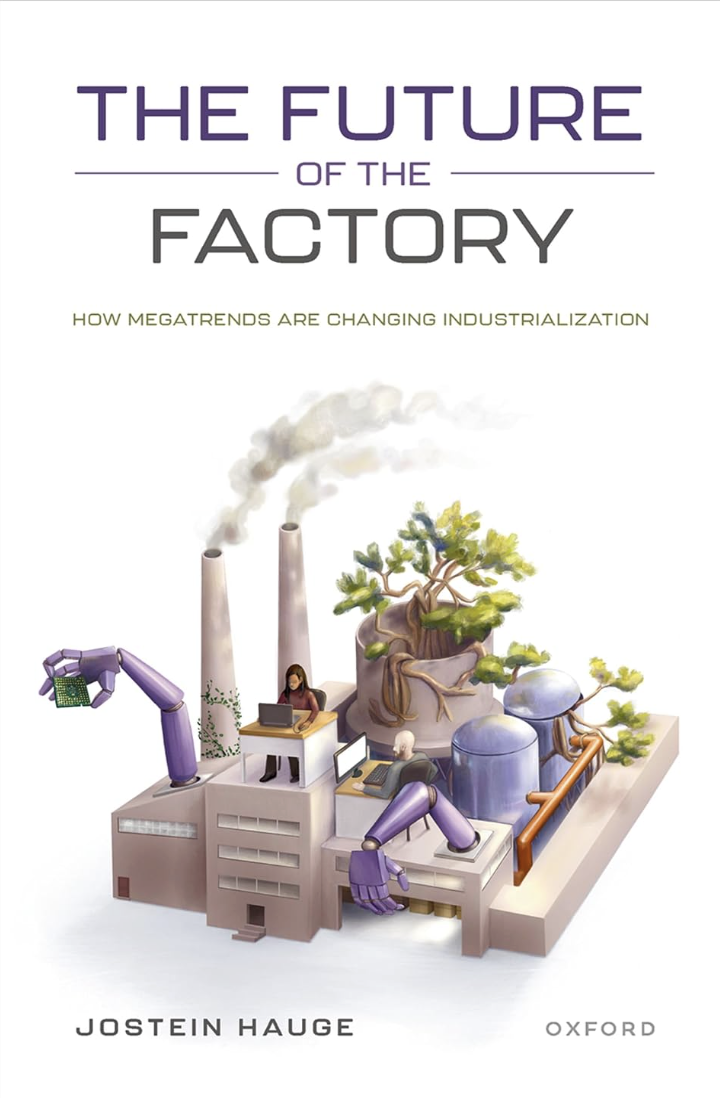
You wrote an entire book on the future of the factory.
Could you briefly discuss the global forces the book argues are currently reshaping the factory?
Jostein Hauge: The forces I discuss in the book are the rise of services, digital automation technologies, the globalization of production, and the green energy transition.
One of the key points I make is that manufacturing continues to be very important for economic development. I ground this in the discussion around digital services as a possible route to development, but if we look at the data and the evidence, there are very few countries that have managed to go from low to high income without following a path of industrialization, as I mentioned earlier in our conversation.
Another important point is that certain power dynamics are making it harder for low-income countries to industrialize. With the emergence of global value chains, power has become consolidated among major corporations in the world, particularly Western-based lead firms in those chains, and it has become hard for low-income countries to break out of the middle-income trap. They can assemble things and reach a certain point in the value chain, but after that, power is so consolidated globally by certain high-income countries that further progress becomes difficult. The one country that has broken through this is, of course, China, but aside from that, we have not seen many other cases of successful development in this way.
On top of that, the climate emergency means industrialization cannot happen the same way it once did, if we care about global warming. I think that, after the publication of my book, public concern about climate change has actually diminished somewhat, perhaps because geopolitics has become more central, or perhaps there is simply a growing sentiment that fewer people care about climate change than before. Clean energy development is increasingly framed as a way to become more competitive geopolitically rather than as a way to save the world. We are also at a point where we cannot fully undo the damage already done due to rising global temperatures, though I still believe we can limit further harm.
Aiden Singh: What do these changes mean for the economic competition between the United States and China?
Jostein Hauge: One thing China really confirms is that a great deal of economic might, power, and development comes from actually building manufacturing capabilities. This has been central to China's development model - the idea that making things matters. And China illustrates it well, since almost its entire economic strength comes from its manufacturing ecosystem.
Another point I highlight in the book, though this is changing somewhat now, concerns the structural power of lead firms and corporations globally. China is rising on the world stage in corporate terms too, but if we look at the structural power of lead firms in global value chains, the most commanding and powerful firms in the world are still American based.
So what I argue in the book is that we are at a point where we have the possibility to construct new rules and a new world order, since WTO rules have proven largely ineffective. We need rules in place to prevent this massive consolidation of corporate power, so that it becomes easier for lower-income countries to develop their economies. Development is also about avoiding the trap many developing countries fell into in the 1970s, 1980s, and 1990s, where they ended up performing simple, low-value tasks for foreign-owned corporations and struggled to move beyond that, because those corporations held so much power that they could simply relocate to other countries with lower labor costs.
So solving the problem of development today is also about encouraging the emergence of brands and corporations from the Global South.
- - - - - - -
States & Markets
Aiden Singh: Based on everything we have discussed, at a broad political economy level of analysis, what lessons can we take from China's development story about the relationship between states and markets?
Jostein Hauge: Let me start by saying that every case of development is unique and cannot be exactly replicated, and the scale of China's development is quite unique in itself.
Still, there are interesting lessons to draw.
One is controlled and gradual liberalization. Around the time China liberalized its economy, other countries in the Global South were also liberalizing, and China was not necessarily much wealthier than them at that point. Many countries in Africa, for example, liberalized extremely rapidly, and the state was almost eroded in many of those countries during the 1980s and 1990s. This proved quite disastrous for growth, as the industrial base was also eroded, with no policies in place to ensure that foreign investment was not simply extracting natural resources.
A second lesson would be establishing mechanisms, when attracting foreign capital, to ensure technology transfer. China did this extensively through joint ventures with foreign firms, ensuring that much of the knowledge and know-how held by those firms was also transferred to Chinese firms.
A third lesson concerns control of the financial system. I do think having a meaningful degree of macroeconomic control matters for lower-income countries: controlling capital inflows and outflows, maintaining development banks or state-owned banks whose job is to mobilize investment, and having a state genuinely in control of where money goes and which sectors are strategic. This contrasts with a fully financialized economy that lacks that same degree of autonomy and control to steer investment in the right direction.
Obviously, all of these things are easier said than done, and they demand, to some degree, what I mentioned earlier, a meritocratic bureaucracy. But I still think there are specific elements of how the Chinese state approached development that can be emulated, in different but comparable ways, by other countries.
——————
Editing by Harpreet Chohan.